Adult Education Center Lindau: Course Offerings, Learning & Creativity
Adult Education Center, Workshops & Courses in Lindau: How to Plan Your Next Learning Semester
For your next months in Lindau: How to navigate the upcoming VHS program, choose suitable courses (languages, health, creativity, career/IT), and register in time.
Looking Ahead: What You Can Expect at VHS Lindau in the Coming Semesters
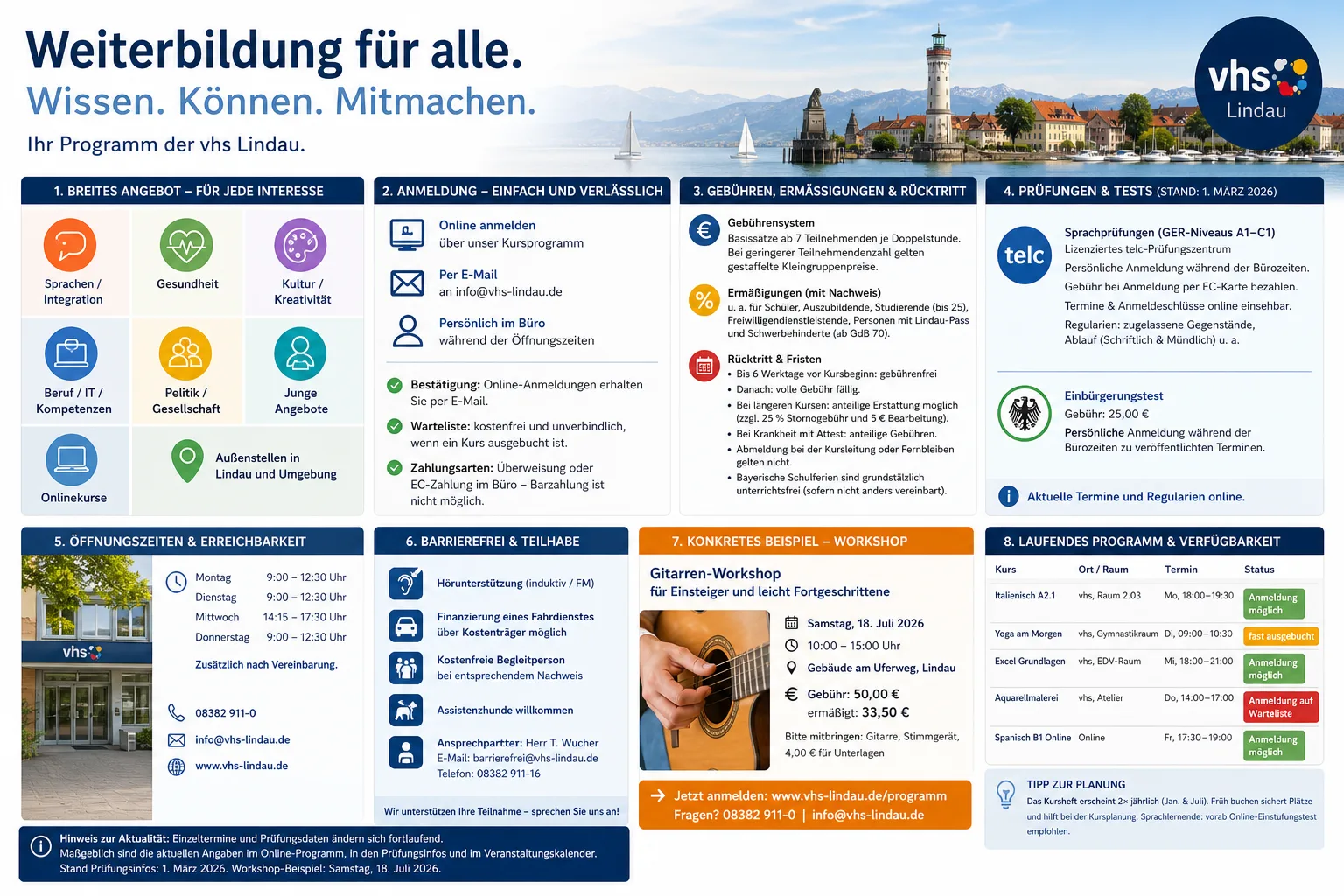
If you want to take on something new in the coming months—a language, a creative course, or more composure in everyday life—the Adult Education Center (VHS) in Lindau is a logical starting point for many. The key factor is timing: Adult education centers usually follow semester periods (typically: spring/summer and autumn/winter). This allows you to translate your learning goals into a concrete schedule: search for a course, check your level, register, note the start date.
To help you find a suitable spot as smoothly as possible in the coming weeks and months, you’ll find a practical guide below: course areas, registration, fee logic, possible exams, as well as notes on accessibility and planning.
Course Areas for the Coming Months: How to Quickly Find the Right Offer
VHS programs are usually divided into subject areas. If you want to select efficiently for the next semester, this approach helps: define your goal (e.g., “consolidate A2” or “strengthen your back”), choose the format (weekly, compact on weekends, online), and check the conditions (time, place, materials, prerequisites).
Languages & Integration: For Your Next Level Step
If you want to start or deepen a language in the coming months, pay particular attention to the entry level and learning objectives (e.g., conversation, grammar consolidation, exam preparation). Many programs are based on the levels of the Common European Framework of Reference (CEFR), which makes selection easier and later supports comparability of learning progress.
Practical for course selection: If a placement test is offered, use it early before registering—this way you plan realistically from the start and avoid unnecessary course changes after starting.
Health & Relaxation: Realistic Routines for the Next Season
Health courses are especially useful for your next semester if you want to build achievable habits—such as exercise, stress regulation, or relaxation techniques. When choosing, pay attention to the course description: target group (beginners/advanced), intensity, possible contraindications, and notes on whether you should bring materials (mat, comfortable clothing).
Important: Health courses, now as in the future, do not replace a medical diagnosis or therapy. If you have complaints, plan a medical check-up before starting the course.
Culture & Creativity: Planned Workshops Instead of “Someday”
If you want a creative break in the coming weeks, compact formats (e.g., day workshops, weekend courses) are often easier to fit into your calendar than longer series. Check three things in advance: materials list, level (beginners/slightly advanced), and goal (learn technique vs. free work).
Especially with smaller workshop groups, early registration can be worthwhile, as these formats often have a limited number of places.
Career, IT & Key Skills: For Your Next Projects at Work
If you want to become more efficient at work in the coming months, plan courses so that they fit a specific project: e.g., “presentation for Q4,” “Excel analysis,” “digital basics,” or “team communication.” For many, a mix is ideal: a basic course (for a solid foundation) plus an advanced workshop (for transfer to real tasks).
If online formats are offered, check the technical requirements in advance (browser, microphone/camera, software) and block out undisturbed learning times in your calendar.
Politics & Society: Schedule Dates, Be Able to Participate in Discussions
Lectures and discussion formats are especially helpful if you want orientation on social topics in the coming months or want to get more involved. For your planning, the main factors are the frequency of dates (single evening vs. series) and the format (lecture, moderated discussion, workshop).
Offers for Children/Youth & Online Courses: Flexible Options for the Next Holiday or School Phase
If you are planning for the next holiday periods or the upcoming school semester, short courses for young participants (e.g., creative, media/technology) or online offers can be a good addition. The key here is to pay attention early to age specifications, duration, supervision situation, and required equipment.
Registration & Participation: How to Prepare for the Next Course Start
Registration Methods You Can Plan for the Next Semester
For upcoming courses, a binding registration is usually required. Often (depending on the offer) several methods are available—typical are:
- Online registration via the digital program/portal
- Registration by email or contact form
- Personal registration during published service hours
If waiting lists are offered, they can help you move up at short notice for fully booked courses. Plan to check your emails regularly so you don’t miss deadlines for accepting a spot.
Fees, Discounts & Small Groups: What You Should Pay Attention to in the Future
For your budget planning in the next semester, three points are important: course scope (number of dates), group size (some courses are more expensive with small groups or are calculated differently as small groups), and discounts (e.g., for certain groups with proof). Always read the fee information together with the terms of participation to avoid surprises later.
If cashless payment methods are provided (e.g., bank transfer or card payment), you can take this into account for your planning and meet necessary deadlines (payment receipt before course start).
Cancellation, Withdrawal & Course Cancellation: Planning Security for the Next Weeks
For upcoming dates, it’s worth checking the withdrawal deadlines before registering. Typically, cancellations are free up to a certain point before the course starts; after that, fees may apply. Course cancellations (e.g., due to too few participants) are also often regulated in the terms of participation. If your schedule is very tight, it’s sensible to read these conditions in advance and keep alternative dates in mind.
Exams & Certificates: Make Goals for the Next Months Measurable
If you want to set a concrete goal for the next half-year, an exam or certificate can be motivating—especially for language courses. The CEFR provides orientation by transparently describing competence levels. Which exams, dates, and registration deadlines are actually offered in the next period depends on the respective program; the published information of the organizing body is binding.
If you are planning an exam, allow enough study buffer in advance (e.g., several weeks of review) so you can go into the exam date without last-minute stress.
Accessibility & Service: What You Should Clarify for Your Next Participation
If you need accessibility or support for upcoming courses (e.g., hearing assistance, companion, assistance dog), it is advisable to contact in advance and coordinate the conditions. This way you can ensure that the room, technology, and organization are suitable for your course start.
Also plan that service times and availability (phone/email/in person) may vary depending on the season. For time-critical matters—e.g., exam registrations—early contact is especially helpful.
Practical Tips: How to Fill the Next Months with Learning Without Overloading Yourself
- Apply a 1-goal principle: For the next semester, first plan a main course (e.g., language or health) and only add optional workshops afterwards.
- Block learning time in your calendar: Reserve fixed slots for travel, practice, and, if applicable, homework—this keeps the course realistic.
- Choose the right format: If your daily routine fluctuates a lot, compact weekend or online formats can be more stable than weekly series.
- Check materials & prerequisites: Plan material costs and level requirements in advance so you are fully prepared at the start.
- Think in semesters: A course is a section. Decide now what you want to be able to do or experience by the end of the semester.
Conclusion: Your Next Step in Lindau Can Be Starting a Course
If you want to learn something new in Lindau in the coming months, a clear, semester-oriented plan will help: choose a subject area, check your level, determine the format, register in time, and read the withdrawal conditions. This way, a good intention becomes a concrete date—and a date becomes a routine that will visibly move you forward over the next semester.