Living Healthy in Lindau: Yoga, Retreat & Relaxation
Living Healthy in Lindau: Courses & Retreats at Lake Constance – Your Outlook & Plan for the Coming Months
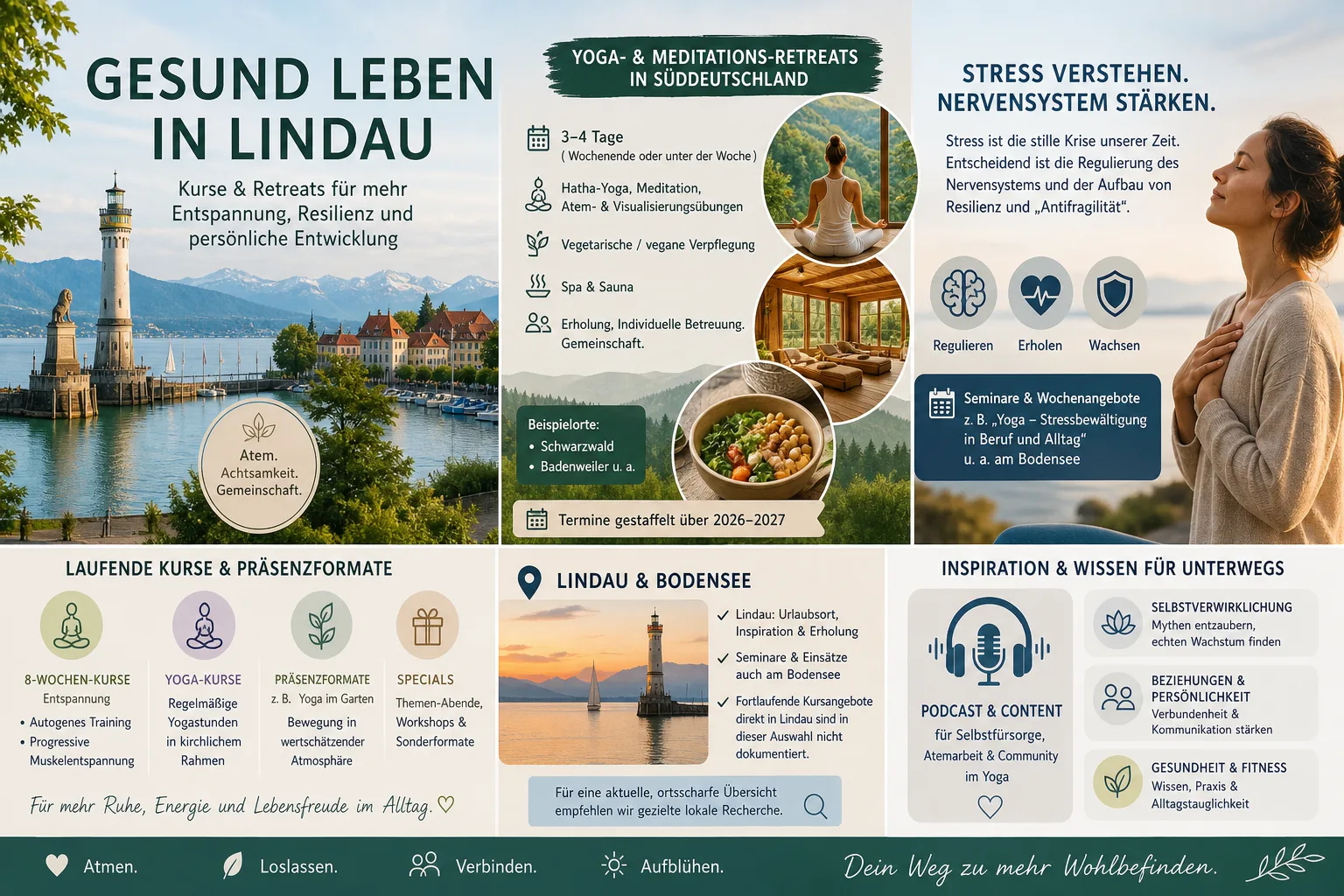
If you want to live more consciously in Lindau (or around Lake Constance) in the near future, you will very likely ask yourself the same question: How do you plan yoga, meditation, and real relaxation so that they are not just a short impulse, but carry you through the next weeks and months? This guide consistently focuses on what is next: how to find suitable formats, how to evaluate them, and how to build a realistic annual plan for your health from them.
What future stress regulation courses typically aim for (and which results are realistic)
If you select courses in the coming weeks, you will very likely encounter terms such as “resilience,” “regulating the nervous system,” “mindfulness,” or “improving sleep” in the descriptions. To keep your expectations realistic, a simple distinction can help: What will be noticeable in the short term and what will develop more in the medium to long term?
What you can expect in the short term (days to a few weeks)
- more body awareness (earlier recognition of tension)
- simpler “wind-down” routines in the evening (breathing, short relaxation session)
- more structure in everyday life (fixed appointments as protection against chronic stress)
What will develop more in the medium to long term (weeks to months)
- more stable habits (e.g., 10–20 minutes of practice on several days per week)
- improved stress competence (setting boundaries earlier, planning breaks more consciously)
- more sustainable effects on sleep and recovery (if regularity develops)
For your next steps, it will also be helpful to check course descriptions to see if they mention concrete methods (e.g., breathing techniques, body scan, progressive muscle relaxation) and if they explicitly plan for a home practice. It is exactly these “in-between times” that will most strongly influence your progress.
Checklist: How to check the quality of yoga, meditation, and relaxation courses
If you compare offers around Lindau in the future, this checklist will help you quickly recognize whether a course is seriously structured and suits you. You can use it directly as a decision aid before you register.
1) Qualification & Transparency
- The instructor will clearly state their training (e.g., yoga teacher training, recognized relaxation methods, therapeutic background).
- It will be clearly described for which level the offer is planned (beginners, gentle, sporty, therapeutic support).
- Contraindications will not be concealed (e.g., in acute psychological crises or certain physical limitations).
2) Content & Structure
- Sessions follow a comprehensible sequence (arrival, practice, integration, short reflection).
- There are practical exercises for home (short, clearly explained, realistically feasible).
- “More” will not automatically be “better”: good progression will take place in measured doses.
3) Safety & Dealing with Boundaries
- You will be encouraged to take breaks and use alternatives.
- Performance pressure will not become a hidden goal; regeneration will be legitimate.
- For intensive formats (breathwork, long meditation), aftercare or integration will be considered.
4) Suitability for your everyday life
- Location, time, and duration will fit your life reality (otherwise you will drop out).
- You will clarify in advance whether you want to participate weekly, every two weeks, or in blocks.
- You will define a minimum that remains achievable even in stressful weeks (e.g., 2×10 minutes).
Planning in Lindau: Three practical future scenarios (Starter, Stabilization, Intensive)
So that you don’t just make “good resolutions” out of the coming weeks, but create an actionable plan, three simple scenarios will help you. Choose the scenario that will most likely work in your current life phase.
Scenario A: Starter (if you have very little time)
- 2× per week for 10–15 minutes each (breath focus or short relaxation sequence).
- 1 appointment per week as a fixed anchor (e.g., gentle yoga course or group meditation).
- 1 micro-ritual daily (e.g., 3 deep breaths before the first look at your phone).
This scenario will mainly provide you with one thing: regularity without overwhelm. This very foundation will later open the door to more intensive formats for you.
Scenario B: Stabilization (if you are already doing something, but it is shaky)
- 1–2 group formats per week (yoga and/or meditation).
- 1 fixed “offline time” per week (e.g., 2 hours without a screen, ideally with a walk).
- Weekly review: 10 minutes in which you plan exactly when your practice will take place in the next week.
This scenario will help you not to do “more,” but to manage better: rhythm, breaks, and priorities will become clearer.
Scenario C: Intensive (if you consciously want to initiate a change)
- 4–6 weeks of preparation: you will keep your minimum stable (e.g., short practice 3× per week).
- Then 3–4 days retreat (yoga, meditation, periods of silence, contact with nature).
- 2 weeks of follow-up: you will translate content into your everyday life (short sequences instead of “everything as in the retreat”).
This scenario will work particularly well if you consciously plan “downtime” after the retreat so that integration rather than overwhelm will occur.
Planning a retreat (3–4 days): How to choose timing, setting, and follow-up
If you are planning a retreat around Lake Constance or within reachable distance in southern Germany in the coming months, you will achieve the greatest effect with three decisions: timing, setting, and integration.
Timing: When your retreat is most likely to be effective
- You will schedule the retreat before a very hectic phase (preventively), rather than only reacting “after the breakdown.”
- Ideally, you will allow yourself a quiet day afterwards at home so that the transition is gentle.
- You will choose the season according to your needs: more retreat in cooler months, more time in nature in warmer months.
Setting: What you will clarify before booking
- Group size: Small groups will be more personal; larger groups are often cheaper and more structured.
- Daily structure: You will check whether there are real breaks (not just “program from morning to evening”).
- Intensity: You will clarify whether the focus is regenerative (gentle yoga, longer recovery) or intensive (long meditation, demanding practice).
Integration: How you will transfer the retreat into your everyday life
- Choose 1–2 core exercises that you will actually continue in everyday life (e.g., 8 minutes of breath focus, 12 minutes of gentle movement).
- Set fixed time slots for the first 14 days afterwards.
- Plan a community connection: You will look for a group or course that “holds” you after the retreat.
- Days 1–2: 10 minutes daily (breath or short relaxation)
- Days 3–4: 15 minutes daily (breath + gentle mobilization)
- Day 5: 20 minutes (short meditation + stretching)
- Day 6: Group practice or joint walk
- Day 7: Weekly review & planning for the next week
Safety & Boundaries: What you should pay attention to in the future with physical and psychological stress
To ensure your next steps remain health-promoting, you will take safety just as seriously as motivation. Yoga, meditation, and relaxation methods will be helpful for many people, but they will not solve every situation alone.
When you should plan for additional medical or psychotherapeutic support in the future
- If you notice persistent insomnia, severe exhaustion, or panic symptoms, you will plan for a professional assessment.
- If you are suffering from acute psychological crises, you will only choose intensive retreat formats (long silence, very intensive breathwork) with professional consultation.
- If you have orthopedic or internal medical limitations, you will choose courses that offer variations and clear instructions.
Note: This article will help you with future planning of courses and retreats, but it will not make a diagnosis and will not replace individual therapy. If you have health complaints, you will seek medical advice.
Sources & Further Links
- AWMF Guideline: Treatment of Anxiety Disorders (S3) — Notes on diagnostics/therapy and distinction from self-help formats (accessed 2026-10-07)
- American Psychological Association (APA): Stress — Overview of stress, effects, and coping approaches (accessed 2026-10-07)
- NIH NCCIH: Relaxation techniques for health — Evidence-based overview of relaxation techniques (accessed 2026-10-07)
- NHS: Mindfulness — Practical classification and safe application in everyday life (accessed 2026-10-07)
- BZgA (Federal Center for Health Education) — Health information and prevention approaches (accessed 2026-10-07)