
Alois Schloder
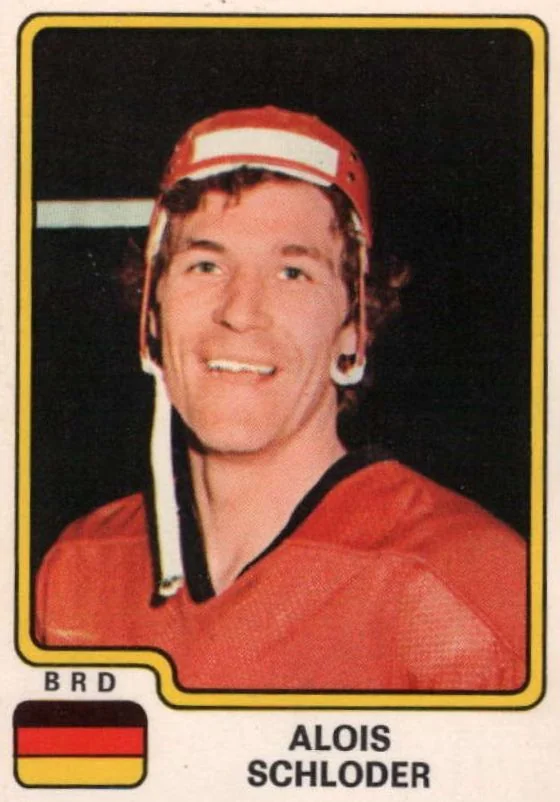
Image from Wikipedia
Image from Wikipedia
Alois Schloder
From the Ice Stadium in Landshut to Olympic Sensation: The Formative Career of Ice Hockey Captain Alois Schloder
Alois Schloder, born on August 11, 1947, in Landshut, is one of the most significant figures in German ice hockey. For over two decades, the right winger with jersey number 15 shaped the dramatic narrative of top-level sports akin to a music career: hard work during training sessions, the grand stage of the Bundesliga, and international highlights with the national team. As a long-time captain, he led the German team to Olympic bronze in 1976 and remained impressively loyal to his home club EV Landshut. His artistic development as an athlete—from a youthful talent to a strong leader on the ice—makes him a key figure of an entire generation of ice hockey players.
Early Years: First Polishing and the Decision to Attack
Growing up in a hockey-enthused family, Schloder became acquainted with the stadium on Gutenbergweg as a child. Initially, he played as a goalie in youth teams, but the desire to score goals prevailed. Through dedicated technical training—skating techniques, edge changes, shot precision—he developed an offensively oriented profile as a right winger from a versatile base game. Even as a teenager, he advanced to the first team of EV Landshut, laying the foundation for an extraordinarily long presence on the professional sports stage.
EV Landshut: Loyalty to the Club, Titles, and Maturity as a Leader
From 1963 to 1986, Schloder played exclusively for EV Landshut—a career accomplishment that stands out in times of rapid transfers. With Landshut, he won the German Ice Hockey Cup in 1969, the first German championship in the club's history in 1970, and a renewed title in 1983. The combination of physical presence, strategic game vision, and reliable finishing made him a constant in a team that defined the tone in German ice hockey for years. Out of respect for his significance, jersey number 15 is no longer issued at EV Landshut.
National Team: Captain, Playmaker, Olympic Medalist
Between 1966 and 1978, Schloder established himself as a mainstay in the German national team: 206 international games, twelve World Championships, and three Olympic participations mark his career. The crowning moment came on February 14, 1976, in Innsbruck, when Germany unexpectedly won bronze. In a tournament characterized by tactical discipline, effective forechecking, and uncompromising work in special teams, Schloder served not only as a scorer but also as a structural anchor between defense and offense as captain. This success remains a milestone in the history of German ice hockey to this day.
Sapporo 1972: A Case, a Rehabilitation, and a Signal for Fairness
During the 1972 Winter Games, Schloder was initially excluded from the tournament following a positive test for an ephedrine-containing substance. A few weeks later, after the medical circumstances were clarified, he was rehabilitated and returned to the national team for the 1972 World Championship. The incident highlighted the still-young doping control practices in winter sports, raised awareness for transparency, and strengthened long-term athlete protection. For Schloder, the incident remained a turning point that he overcame with performance and integrity.
Career Summary: Numbers that Tell Stories
In 23 Bundesliga years, Schloder played 1,085 games for EV Landshut, scoring 631 goals. These signature numbers alone document his consistency and compositional sense for finishes from the right half-space. In the national team, he recorded 206 appearances and 87 goals—a yield that underscores his international impact. The statistics create a resonant space for a career characterized by game intelligence, timing, and cool finishing.
Playing Style and Leadership: The Arrangement of Speed, Physicality, and Precision
As a right winger, Schloder combined powerful edge and curve play with a direct approach to the goal. His left-handed shot was fast, straight, and especially dangerous in power-play situations. Characteristically, he had the ability to time his off-puck runs so that teammates found clear passing windows in the buildup. As captain, he managed line changes, dictated the pressing tempo, and stabilized the team during critical phases—a stage presence of quiet authority that inspired teammates and engaged opponents.
1983: A Masterpiece of a Generation
The German Championship in 1983, with a Landshut core including Schloder, Erich Kühnhackl, and Klaus Auhuber, is regarded as a late masterpiece and a link between earlier successes and the more professional Bundesliga era. Playoff experience, tactical discipline, and a deep bench were crucial in decision-making on significant evenings. The title year solidified Schloder's status as a club icon, whose artistic evolution on the ice became a blueprint for subsequent Landshut forwards.
Awards and International Recognition
For the Olympic triumph of 1976, the national team received the Silver Laurel Leaf, the highest sporting honor in Germany. Internationally, the IIHF recognized Schloder's contributions by inducting him into the Hall of Fame in 2005. This honor places his career within the canon of European ice hockey greats and demonstrates how sustainably his performance and leadership were perceived across club and national borders.
Works and Legacy: Chronicler of an Ice Hockey City
After his active sports career, Schloder transitioned to the background—as a chronicler, curator, and narrative voice of his ice hockey city. Together with Helmut Stix, he published the monumental, richly illustrated chronicle of EV Landshut in two volumes, raising significant funds for youth development. The work meticulously documents games, standings, coaches, player rosters, and media reception. It is significant both in sports history and cultural history: an encyclopedic discography of Landshut's ice, creating and preserving identity.
Cultural Influence: The Alois Schloder Cup and the School of Values
Since his retirement, the Alois Schloder Cup has been awarded annually in Landshut to the most exemplary young player. This award honors not only statistical performance but also team spirit, training ethic, and responsibility—virtues for which Schloder stands. The list of awardees includes future national players and NHL professionals; it serves as a culturally significant transmission of standards in technique, tactics, and attitude. Thus, the name Schloder has long transcended his own era, becoming relevant in educational, social, and sporting contexts.
Present: Stadium Tours and Living Memory
Currently, Schloder leads guided tours through the modernized Fanatec Arena in Landshut. The tours combine architecture and construction history with equipment and tactical explanations, showcasing locker rooms, press rooms, and picture galleries—a curated journey through time that makes ice sports a cultural heritage of the region. The proceeds support youth development at EVL, blending sports expertise, community spirit, and educational aspirations. Schloder continues to be a reliable mediator between tradition and the future.
Classification: Expertise, Authority, Trustworthiness
Schloder's sports career convinces through verifiable successes, documented statistics, and independent recognition by associations, museums, and the press. In the historical analogy of ice hockey, he represents the classic narrative of the great repertoire: technical virtuosity, disciplined arrangement, and competent leadership of an ensemble at the highest level. His work as a chronicler fulfills the criteria of source criticism and provides material for science, journalism, and fan culture—robust, verifiable, and citable.
Conclusion: Why Alois Schloder Captivates
The story of Alois Schloder is one of an athlete who never left his home stage yet generated international resonance. Loyalty to his club, leadership strength, and precision merged into an artistic signature on the ice that resonates across generations. Those who want to understand how ice hockey sounded and sounds in Germany find in Schloder the reference point. His message to the present is to experience the magic of the game live—best at the place where his career began and where his legacy continues to thrive.
Official Channels of Alois Schloder:
- Instagram: No official profile found
- Facebook: No official profile found
- YouTube: No official profile found
- Spotify: No official profile found
- TikTok: No official profile found
Sources:
- Wikipedia – Alois Schloder
- Wikipedia (EN) – Alois Schloder
- IIHF – Hall of Fame (Entry for Alois Schloder)
- House of Bavarian History – Eyewitnesses: Alois Schloder
- House of Bavarian History – Olympics Portal: 1976 Alois Schloder
- City of Landshut – Stadium Tours with Alois Schloder (2025)
- EV Landshut – Tours with Alois Schloder (2025)
- EV Landshut – Alois Schloder Cup (2025)
- EV Landshut – Alois Schloder Cup (2024)
- City of Landshut – EVL Championship Team 1983 (2023)
- Sonntagsblatt – "Miracle of Innsbruck" (2020)
- Wikipedia: Image and Text Source
Upcoming Events
Experience stadium air with ice hockey legend Alois Schloder
Exhibition Opening: Landshut Olympians at the Olympic Winter Games 1968-2022
Exhibition: Landshut Olympians at the Winter Olympics 1968 to 2022
Experience the stadium atmosphere with ice hockey legend Alois Schloder