
Cécile Verny Quartet
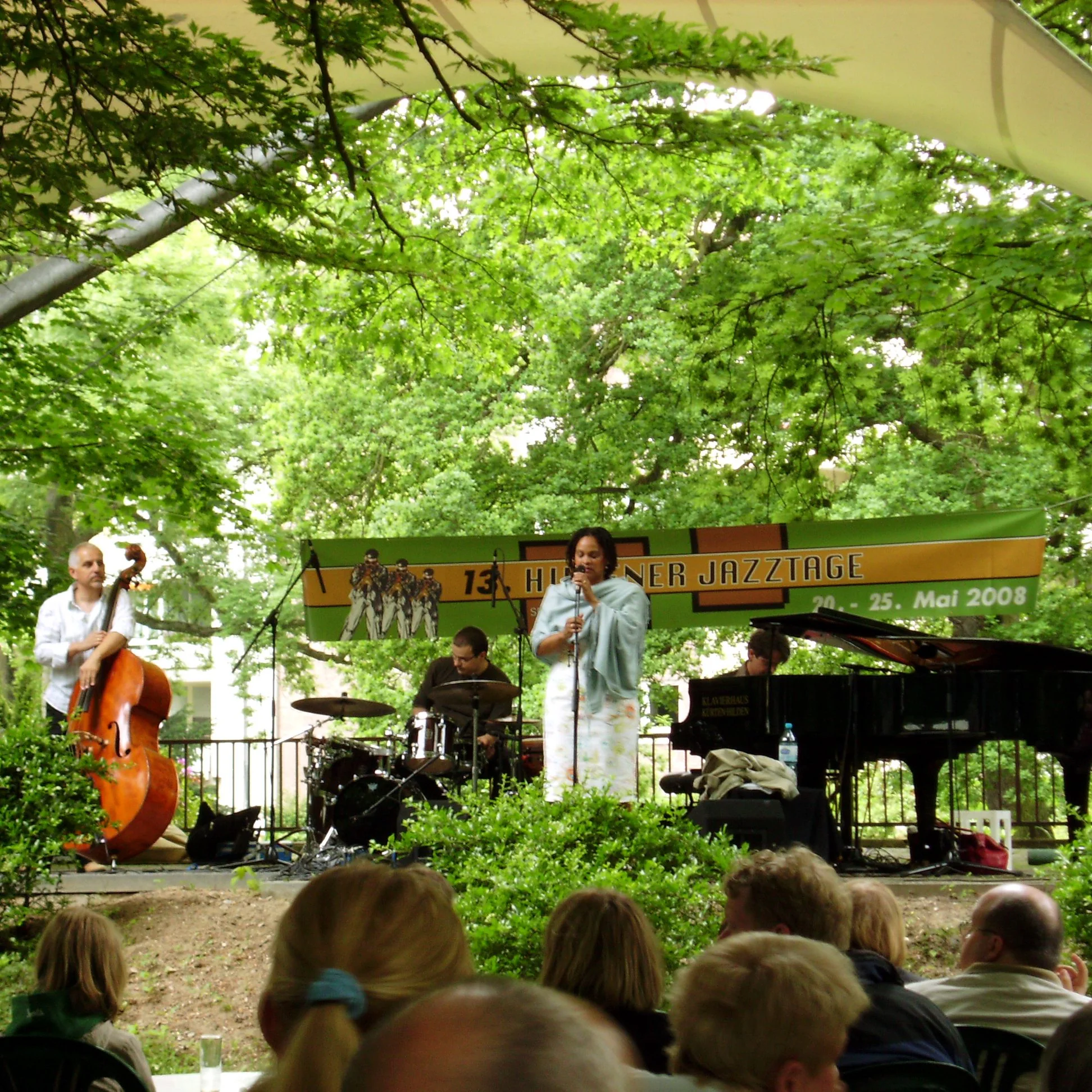
Image from Wikipedia
Image from Wikipedia
Cécile Verny Quartet – Jazz with Soul, Refinement, and International Appeal
One of the most distinctive voices in European jazz
The Cécile Verny Quartet has been one of the most unique formations in Franco-German jazz for decades. Founded in 1987 in Strasbourg, the band evolved from a promising ensemble to an internationally regarded group, convincing with stylistic openness, strong stage presence, and a distinctive vocal signature. At the center is Cécile Verny, born in Abidjan, raised in France, and since the late 1980s, a resident of Freiburg im Breisgau.
The quartet's music thrives on tension and elegance, drawing from jazz tradition and personal expressiveness. Verny's voice combines French chanson aesthetics, scat, soul, blues, and influences from Afro-Caribbean and African music into a sound language that is immediately recognizable. The ensemble is not just an accompanying band but a creative unit with a clear identity that has organically developed over the years.
Biography: From Abidjan through France to Freiburg
Cécile Verny was born in 1969 in Abidjan and moved to France at the age of twelve. There, her musical horizons initially opened to pop, reggae, soul, and funk, before she discovered jazz as a young adult. The path to finding her own voice did not follow academic routines, but instead stemmed from curiosity, experience, and the desire to craft lyrics and sound colors herself.
In 1987, she founded the Cécile Verny Quartet in Strasbourg, and two years later, Freiburg im Breisgau became her new base. This geographic movement also shapes her artistic biography: African origins, French socialization, and a German place of work merge into a European jazz personality with a vast cultural radius. Verny began writing her own lyrics early on, often in French and English, later also in German.
Career beginnings and artistic profile
The quartet established itself during a time when European jazz was searching for new vocal forms. Instead of mere standards, the band quickly focused on originality, compositional independence, and a repertoire that deliberately blurs stylistic boundaries. Even in the early phases, it became clear that Verny is not only a singer but also a narrative artist who closely links content, language, and musical dramaturgy.
Over the years, the core lineup solidified with Bernd Heitzler on bass, Andreas Erchinger on piano, and Lars Binder on drums; previously, Torsten Krill was on drums. This configuration provided the sound with stability while also offering flexibility. The balance between rhythmic precision, harmonic depth, and vocal freedom made the quartet a sought-after live band with a strong recognition factor.
Musical development: Between jazz, chanson, blues, and African colors
Stylistically, the Cécile Verny Quartet never confines itself to a narrow genre corridor. In addition to modern jazz, French chanson traditions, scat singing, rock, blues, and African music shape the ensemble's signature. On albums like European Songbook, arrangements by Michael Gibbs and Carinne Bonnefoy were incorporated, further emphasizing the project's ambition: to not only interpret songs but to re-model musical narratives.
Verny's singing is considered intense, phrased, and expressive; critics have repeatedly compared her voice to Ella Fitzgerald's. What matters is not only the technique but also the way she conveys meaning: with subtle dynamics, controlled freedom, and strong dramatic presence. The result is jazz that remains emotionally open while also appearing precisely constructed.
Key milestones in the discography
The quartet's discography documents a continuous artistic maturation. Early releases include Oazoo (1992), Patchwork (1995), Expressive Impressionen (1995), Coquelicot – melodie de vie (1997), Got a Ticket (1998), and Métisse (1999). These early albums already showcase the characteristic mix of stylistic openness, melodic independence, and vocal power.
With Kekeli (2002), the live document Cécile Verny Quartet – live in Antibes (2004), The Bitter and the Sweet (2006), Amoureuse (2008), Keep Some Secrets Within (2010), Fear & Faith (2013), Memory Lane (2014), and Of Moons and Dreams (2019), the ensemble condensed its artistic language. Several titles became standout pieces in the repertoire, including “The Bitter and the Sweet,” “Money,” “Kekeli,” and “The Power to Be.”
Awards, recognition, and critical reception
The quartet has received significant awards, including the Grand Prix du Jury from the Jazz à Juan Festival in Antibes/Juan-les-Pins. It has also been recognized by the Preis der deutschen Schallplattenkritik, particularly in connection with the album The Bitter and the Sweet. Such accolades demonstrate that the band is taken seriously in the professional jazz discourse as well as by the audience.
International responses include a review in DownBeat magazine, which made the quartet visible beyond the Franco-German realm. The band has toured for Goethe institutes and performed in countries such as Morocco, Kenya, South Africa, and Sudan. This international presence underscores the authority of a formation that has developed its music with cultural openness and extensive travel.
Current projects and new musical paths
Even after many years, the Cécile Verny Quartet is far from being museum-like; instead, it remains vibrant and contemporary. New songs have been announced for 2025, which will play an important role alongside classics from the repertoire in programs and concerts. The current announcements emphasize that the ensemble continues to develop new pieces and expand its sound spectrum.
Additionally, Verny's surroundings demonstrate a strong desire for side projects and conceptual expansions. On the official website, "my song repertoire" and "sing-along" are listed as further artistic fields that reflect Verny's interest in the German language, new interpretation, and dialogical music-making. This makes her work particularly exciting: she remains rooted in jazz while simultaneously opening spaces for new forms of musical storytelling.
Stage presence and live quality
The true strength of the Cécile Verny Quartet is revealed on stage. Reports about concerts consistently emphasize the intensity, emotional range, and immediate impact of the band. Verny confidently guides the audience through complex moods without losing the lightness of the moment.
Especially live, the unique blend of virtuosity and accessibility unfolds. The quartet plays with dynamics, space, and improvisation, while still keeping the song in focus. This balance makes the ensemble's concerts musical experiences that captivate not only jazz enthusiasts but also listeners seeking emotional depth and strong melodies.
Cultural influence and artistic significance
The Cécile Verny Quartet represents a form of European jazz that understands origins not as a box but as a resource. In Verny's work, African influences, French lyric culture, and German musical practices intersect, creating a personal, cross-border sound world. Thus, the ensemble possesses cultural-historical significance that extends beyond mere discography.
The band has demonstrated over decades how jazz functions as an open art form: as a dialogue between tradition and present, between composition and improvisation, between language and sound. This is precisely where its relevance lies for both music lovers and professionals alike. The Cécile Verny Quartet is not a passing fad but a well-established artistic institution with a distinctive voice.
Conclusion: A quartet with character, depth, and enduring presence
The Cécile Verny Quartet fascinates with a rare combination of emotional directness, stylistic sovereignty, and international experience. Those who listen to this ensemble experience jazz that is elegant, intense, and culturally multifaceted. The band has developed a clear identity over decades and remains all the more intriguing for it.
Anyone wishing to experience strong live moments, sophisticated compositions, and a singer with extraordinary expressiveness should definitely see the Cécile Verny Quartet perform on stage. This music carries within it stories, origins, and the present and unfolds its full grandeur where jazz is most alive: in concert.
Official channels of Cécile Verny Quartet:
- Instagram: No official profile found
- Facebook: No official profile found
- YouTube: No official profile found
- Spotify: No official profile found
- TikTok: No official profile found
Sources:
- Cécile Verny – Official Website
- Cécile Verny – Bio
- Wikipedia – Cécile Verny Quartet
- Wikipedia – Cécile Verny
- Apple Music – Cécile Verny Quartet
- visit.freiburg.de – Cécile Verny Quartet Live 2025
- Cécile Verny – my song repertoire
- Schwarzwälder Bote – Concert Review
- Melodiva – Concert Dates
- Saarjazz – WND JAZZ 2025
- Wikipedia: Image and text source