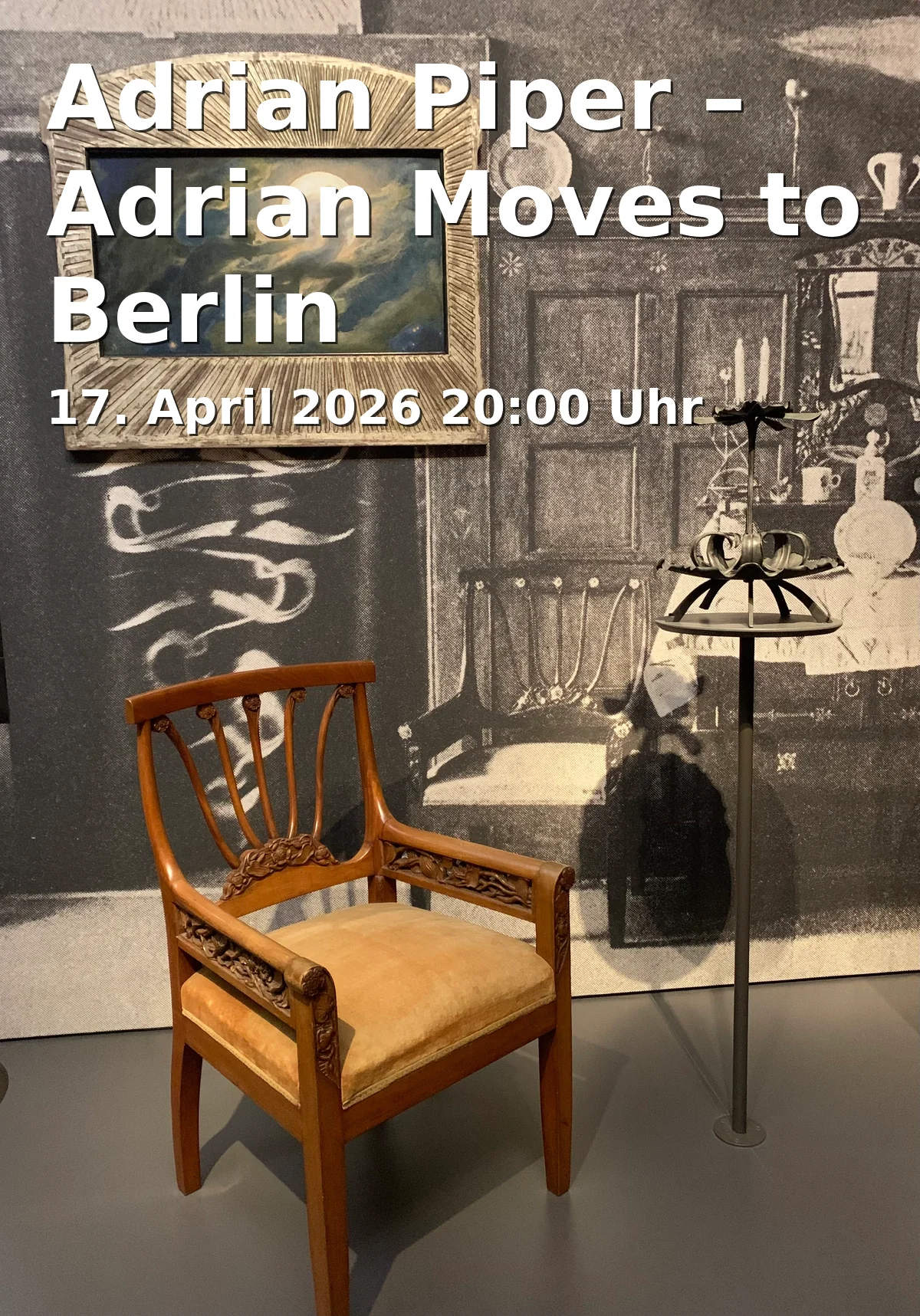
Adrian Piper

Image from Wikipedia
Image from Wikipedia
Adrian Piper: Conceptual Art, Philosophy, and the Radical Precision of an Extraordinary Body of Work
An artist who has remeasured thinking, identity, and perception
Adrian Margaret Smith Piper, born on September 20, 1948, in New York City, is one of the most influential conceptual artists of the first generation and a significant analytical philosopher of her time. Her work combines art, ethics, identity politics, and self-observation with an intellectual sharpness that has set standards for decades. Since 2005, she has lived and worked in Berlin, where she operates the Adrian Piper Research Archive Foundation, archiving, reflecting on, and making her multidisciplinary oeuvre publicly accessible. (adrianpiper.com)
Biographical roots: New York, education, and early international presence
Piper studied at the School of Visual Arts in New York, graduating in 1969 with an A.A. in Fine Art; concurrently, she was already developing her language between painting, sculpture, concept, and performance. At the City College of New York, she earned a B.A. in Philosophy in 1974, focusing on medieval and Renaissance musicology, before completing her Ph.D. in Philosophy at Harvard University in 1981 under John Rawls. The combination of artistic practice and philosophical rigor shaped her approach from the beginning and continues to lend an exceptional analytical depth to her work today. (adrianpiper.com)
By the age of twenty, Piper was already exhibiting internationally. She gained early attention in the New York avant-garde, notably with contributions to experimental publications such as 0 to 9 and her first solo and post-art projects that made her radical independence visible. These early works established Piper as an artist who did not wait for the secure confines of a museum but understood the public as the material of her art. (en.wikipedia.org)
Career development: Performance, provocation, and the language of the social
In the 1970s, Piper developed her well-known street performances under the title Catalysis. These actions engaged with irritation, social friction, and the conscious transgression of public norms; clothing, gestures, and behavior became instruments of critical analysis. Piper examined how society responds to bodies, skin color, gender, and "conforming" appearances, thus creating an early, uncompromising form of institutional and social critique. (en.wikipedia.org)
Another milestone in her musical career, broadly defined as cultural practice, were the Funk Lessons of the 1980s. Between 1982 and 1984, Piper invited participants to learn dance styles, culture, and history of funk, thus connecting music, bodily knowledge, and social experience. These works particularly demonstrate how Piper understood rhythms, movements, and social codes as artistic material. (en.wikipedia.org)
Later works such as The Mythic Being, Cornered, or What It’s Like, What It Is became key works of art that treat identity not as a fixed essence but as a contentious field of societal attributions. The works intertwine text, image, performance, video, and installation, making Piper one of the most influential voices in conceptual art since the late 1960s. Her practice remains double-readable: as an aesthetic form and as a philosophical experiment. (paulacoopergallery.com)
Philosophy as an artistic resonance space
Adrian Piper taught philosophy at Georgetown, Harvard, Michigan, Stanford, and UCSD; in 1987 she became the first tenured African American woman in the field of philosophy at Georgetown University. This academic career is not a side path but a core aspect of her artistic authority: Piper conceives of art as a place of insight, ethics, and self-examination. Her essays and theoretical texts, collected among others in Out of Order, Out of Sight, continue to shape the discourse on conceptual art today. (adrianpiper.com)
Moreover, her engagement with musicology and yoga expands the horizons of her work. In the materials of the APRA Foundation, music, Vedic philosophy, Western philosophy, and artistic practice are explicitly listed as interconnected fields of collection and research. This creates the image of an artist who does not separate disciplines but brings them into productive tension. (adrianpiper.com)
Awards, recognition, and international reception
Piper's work has been recognized early on and over decades in major institutions. Her retrospective Adrian Piper: A Synthesis of Intuitions 1965–2016 at the Museum of Modern Art in New York received particular attention; the presentation occupied the entire sixth floor for a living artist for the first time in the museum's history. The official archive page also notes that the exhibition was deemed "the most important exhibition of the year" by ARTnews. (adrianpiper.com)
In 2024, her eighth retrospective RACE TRAITOR, also her first European retrospective in more than twenty years, opened at PAC Milan. This continuity of international visibility underscores the rare status of her work: Piper is not only historically relevant but continues to produce contemporary art of high urgency. (adrianpiper.com)
Additional honors and recognitions include the Golden Lion of the Venice Biennale for her work in 2015, as well as recognition by the Women’s Caucus for Art Lifetime Achievement Award. Such honors mark not only personal successes but also the long-term shifting of art historical standards, to which Piper has significantly contributed. (adrianpiper.com)
Current projects and work at the archive
The Adrian Piper Research Archive Foundation remains a central place for her current work. Founded in 2022, the Foundation supports multidisciplinary research in art and science and preserves an extensive archive of artworks, correspondence, manuscripts, video and audio materials, libraries, and documents. This structure shows that Piper's presence is not only comprised of new exhibitions but also involves the ongoing preservation of her intellectual legacy. (adrianpiper.com)
Ongoing announcements on the official pages of the Foundation cover conversations, publications, audio and video archives, as well as the international reception of her work. For 2025, the Foundation announced the selection of a Multidisciplinary Fellow, referring to conversations and archival materials that further unlock Piper's work from philosophical, art historical, and journalistic perspectives. (adrianpiper.com)
Work, style, and cultural influence
Adrian Piper has not only expanded the language of conceptual art but has also shifted it. Her works connect the minimalism of the formal means with the maximum intensity of the statement, often driven by text, reflection, self-staging, and a precise understanding of social power dynamics. Her art is never decorative; it demands analysis, friction, and self-inquiry, which is why it remains relevant for exhibitions, seminars, and theoretical debates to this day. (adrianpiper.com)
Piper’s influence is particularly strong where art, identity, and the public sphere intersect. She has addressed themes such as racism, perception, attribution, and exclusion in a way that is both museum-worthy and socially impactful. The fact that her works are present in museum collections, galleries, and archives worldwide speaks to the enduring cultural relevance of an artist who translates thinking into action. (en.wikipedia.org)
Conclusion: Why Adrian Piper continues to fascinate
Adrian Piper is an exceptional figure because she does not position art and philosophy next to each other but develops them as a shared system of knowledge. Her career tells of intellectual consistency, aesthetic courage, and a rare ability to transform societal conflicts into precise artistic forms. Anyone interested in conceptual art, performance, identity politics, and the intellectual architecture of the present finds Piper to be an indispensable reference. Her impact is most strongly experienced in the exhibition space, where her works unleash their full dialogic power. (adrianpiper.com)
Official channels of Adrian Piper:
- Instagram: No official profile found
- Facebook: No official profile found
- YouTube: No official profile found
- Spotify: No official profile found
- TikTok: No official profile found
Sources:
- Adrian Piper Research Archive Foundation Berlin – Biography
- Adrian Piper Research Archive Foundation – News
- Adrian Piper Research Archive Foundation – The Research Archive
- Adrian Piper: A Synthesis of Intuitions 1965–2016 – Official Archive Page
- Paula Cooper Gallery – Adrian Piper
- Wikipedia: Adrian Piper
Upcoming Events
Adrian Piper – Adrian Moves to Berlin