
Charles Bukowski
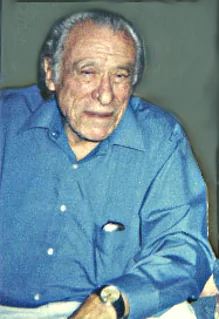
Image from Wikipedia
Image from Wikipedia
Charles Bukowski – Poet, Novelist, and Cult Figure of the Literary Underground
A Life Between Los Angeles, Literature, and Radical Honesty
Charles Bukowski, born on August 16, 1920, in Andernach and died on March 9, 1994, in San Pedro, Los Angeles, is considered one of the defining German-American authors of the 20th century. His music career, in a strict sense, did not exist – yet his stage presence at readings, his laconic delivery, and the release of numerous recordings featuring live readings made him a charismatic voice of pop culture. Through poetry, prose, columns, and screenplays, he created a body of work that exemplifies the "artistic development" from outsider to canonical author. In poems, novellas, and novels, he observed daily work life, poverty, relationships, alcohol, and gambling – always in direct, unfiltered language.
Having moved to Los Angeles at an early age, Bukowski found there the social and cultural climate that permanently shaped his "composition" of characters, motifs, and environments. He published continuously from the late 1950s and became a cult author in the underground scene, before the literary public recognized his authority and significance. By the time of his death, he had published over forty books – posthumously, numerous editions and recordings have secured his reach into the present.
Early Years: Migration, Outsider Status, and the City as Fate
The Bukowski family moved to the USA in 1923; Los Angeles became the axis of life for the young author. Physical and social exclusion due to severe acne, an authoritarian upbringing, and precarious conditions shaped his perspective – an experiential basis that appears literarily condensed in his bildungsroman "Ham on Rye" (1982). Here already, the later "artistic development" is evident: the insistence on unembellished observations, the refusal of bourgeois masks, and a language that avoids metaphorical overload, thereby unfolding a particular immediacy. Biographical stations at colleges, brief jobs, and early publications in small magazines mark the phase of searching for voice and form.
These years were also characterized by travels, experiences of rejection from the publishing world, and a decade during which he completely gave up writing. It was only in the mid-1950s that he began to publish poems again, laying the foundation for his later "authority" in the literary scene. The urban space of Los Angeles – bars, rented rooms, race tracks, backyards – became a permanent resonating space for his texts and a stage for characters struggling against social gravity and inner demons.
Work, Alcohol, Writing: The Shift to Prose and the Breakthrough
A turning point in his music career in a figurative sense – his career on the stage of literature – was reached in 1969/70: at the initiative of publisher John Martin (Black Sparrow Press), Bukowski quit his job at the U.S. Postal Service and wrote his first novel "Post Office" (German: "Der Mann mit der Ledertasche", 1971/74) in just a few weeks. This step from lyricist to prose author opened the mass market to him without abandoning the aesthetic signature of the underground. "Post Office," "Factotum" (1975), and "Ham on Rye" (1982) refine his arrangement of dry observation, autobiographical perspective, and sarcastic humor.
Black Sparrow Press established itself as the home publisher for most of his central books, designed with the iconic Barbara Martin covers. Later, Ecco/HarperCollins took over significant parts of his catalog and kept the "discography" of his books – in the sense of an ongoing edition of his works – available in retail. This publishing continuity underpins his authority in the canon and promotes his international reception. Critics described Bukowski as the "King of the Underground," also noting him as an author with a sharp ear for rhythm, speaking rhythm, and the music of everyday language.
Henry Chinaski and the Poetics of Everyday Life
With Henry Chinaski, Bukowski created his literary alter ego – a rough, vulnerable, and self-ironic chronicler. In composition and narration, he works with serial miniatures: short, concise sentences, free verses set like beats. This method of production generates tempo and directness, a dramatic condensation that pulls readers immediately into scenes. Thematically, his texts revolve around work experience, desire, failure, drinking, gambling – radically de-romanticized, yet not without tenderness in the subtext.
Music frequently appears as a subject or as a silent companion: classical music on the radio, jukebox songs, rhythmic monologues. In the sequence of short paragraphs and the alternation of speaking rhythm and sudden pauses lies a formal kinship to the song stanza – a form of "spoken sung" literature that unfolded into performative power during readings. This aesthetic also explains why his texts are so frequently set to music, quoted, and adapted into spoken-word formats.
Readings, Stage, Recordings: Bukowski as a Live Experience
His stage presence was legendary: polarizing performances that navigated between wit, provocation, and rough intimacy. Readings in San Francisco, Hamburg, and Vancouver were disseminated as vinyl, cassettes, CDs, and later as films and DVDs. The notorious live album "Poems & Insults" (1975) or later recordings showcase how strongly voice, timing, and pauses enhance the effect of his texts – a performance art that intertwines narrative, poetry, and entertainment. For many, the live reading remained the most authentic form of the Bukowski experience.
At the same time, film projects contributed to his popularization: "Barfly" (1987), based on his screenplay, translated the Bukowski world into images – a result he thematized in "Hollywood" (1989). Documentary series such as "The Charles Bukowski Tapes" preserved his statements, habitus, and poetic self-description. This media presence complemented the printed work and made his art accessible even to those who first encountered him through sound and image.
Bibliography and Selected Works
Among the poetry collections, "Flower, Fist and Bestial Wail" (1959), "It Catches My Heart in Its Hands" (1963), "Mockingbird Wish Me Luck" (1972), "Love Is a Dog from Hell" (1977), "War All the Time" (1984), and "You Get So Alone at Times That It Just Makes Sense" (1986) mark the axes of development in his poetry. In prose, "Post Office" (1971), "Factotum" (1975), "Women" (1978), "Ham on Rye" (1982), "Hot Water Music" (1983), "Hollywood" (1989), and the posthumously published "Pulp" (1994) stand as fixed points of a discography in the broader sense that skillfully undermines genres.
Influential collections such as "Notes of a Dirty Old Man" (1969) compile his columns for underground newspapers. Posthumous volumes – from "Slouching Toward Nirvana" (2005) to "The People Look Like Flowers at Last" (2007) – showcase the immense material richness of his archive and the editorial work of his publishers. Modern editions like "Essential Bukowski" keep the work present for new generations of readers and curate his oeuvre from a canonical perspective.
Critical Reception, Controversies, and Canonization
Bukowski polarized: while some dismissed him as a misogynistic voice of bar and back alley worlds, others assessed his texts as brutally self-critical, profoundly human chronicles of modernity. Historically, he can be positioned between "Dirty Realism" and transgressive fiction; his influence on pop and counterculture from the 1970s to the 1990s is unmistakable. Translated into numerous languages, he is now a firmly established part of the literary modernity of the USA.
For the EEAT pillars, his career provides clear evidence: experience (years of "work at the post office," precarious living and working conditions), expertise (an independent poetics from free verse, narrative condensation, precise arrangement), authority (home publishing at Black Sparrow, later Ecco/HarperCollins editions, continuing presence in reputable reference works), and trustworthiness (extensively documented biography, recorded readings, lasting reception in literary criticism and feuilleton).
Los Angeles as Soundscape: Style, Form, and Theme
The city as a soundscape: Bukowski's sentences function like beats. Short, percussive lines, few metaphors, but an observational pressure. His compositions rely on repetition, variation, ritardandi, and abrupt breaks – an arrangement reminiscent of minimal music, yet utilizing the materials of the street: noise, voices, neon flicker. This technique charges his prose with lyrical energy and makes his poetry narrative.
Thematically, the texts oscillate between despair and defiance, compassion and scorn, comedy and melancholy. The literary effect arises from the tension between sparse diction and existential depth. Thus, the lasting impact on spoken word, indie literature, and pop culture can be explained – Bukowski invented the tonality of an urban modernity that resonates to this day.
Legacy, Editions, and Current Relevance (2024–2026)
Even decades after his death, Bukowski remains present: Ecco/HarperCollins keeps central titles available, curates new editions and audio formats. In 2024, "Essential Bukowski" was released as an audiobook edition; library catalogs and commercial platforms document the continuous availability and re-presentation of his catalog. Media contributions from 2025/2026 honor his legacy and discuss the ambiguities of pose, authenticity, and timeless readability.
Simultaneously, historical readings and documentaries remain accessible, allowing for the performance dimension of his art to be traced. Publishing transfers – from the iconic Black Sparrow design to Ecco – ensure visibility in the book market. Research, biographies, and the unlocking of archives contribute to preserving Bukowski as part of the literary memory of the USA.
Cultural Influence and Pop Connections
Bukowski's language became a reservoir for pop culture: quotes in songs, spoken-word adaptations, documentaries, and feature films made his work familiar to a wide audience. His influence reaches from independent literature to visual culture, from club readings to academic engagement. The circulation of his readings on recordings highlights the musical quality of his voice and the rhythm of his texts.
His figure combines outsider pathos with unflinching humor. This aesthetic mix explains why Bukowski is read worldwide – regardless of cultural boundaries. The "stage presence" of the author, both in person and in text, remains a catalyst for discussions about authenticity, images of masculinity, class reality, and poetic ethics.
Conclusion: Why Bukowski Still Electrifies Today
Charles Bukowski fascinates because his literature shows the fall height of life without detours – and makes art from it. His work is uncompromising, vulnerable, often vulgar, and at the same time imbued with a rare tenderness for the fallen. Those who read his poems and novels or listen to his readings experience literature as an immediate experience: rhythm, voice, observation – a poetics that requires no posing while magnetizing nonetheless. Anyone wanting to experience this raw, clear-sighted literature live should attend today’s readings, stage adaptations, and audio productions: Bukowski resonates most strongly when his texts sound.
Official Channels of Charles Bukowski:
- Instagram: No official profile found
- Facebook: No official profile found
- YouTube: No official profile found
- Spotify: No official profile found
- TikTok: No official profile found
Sources:
- Wikipedia (DE) – Charles Bukowski
- Encyclopaedia Britannica – Charles Bukowski: Biography, Books & Facts
- Poetry Foundation – Charles Bukowski
- Wikipedia (EN) – Charles Bukowski (Life, Work, Readings)
- Wikipedia – Black Sparrow Press (Publisher History)
- Wikipedia – Ecco Press (HarperCollins Imprint)
- Bukowski.net – About (Note on Rights Management via HarperCollins/Ecco)
- Apple Music – Charles Bukowski (Readings/Recordings)
- Prime Video – The Charles Bukowski Tapes
- Kobo – Essential Bukowski (Ecco/HarperCollins, 2016)
- Kobo – Essential Bukowski (Audiobook, Ecco/HarperCollins, 2024)
- El País – Report on Life and Impact (16.01.2025)
- Wikipedia: Image and Text Source
Upcoming Events
Charles Bukowski – An Evening with Hank (Edelsfeld)