Ensemble Modern
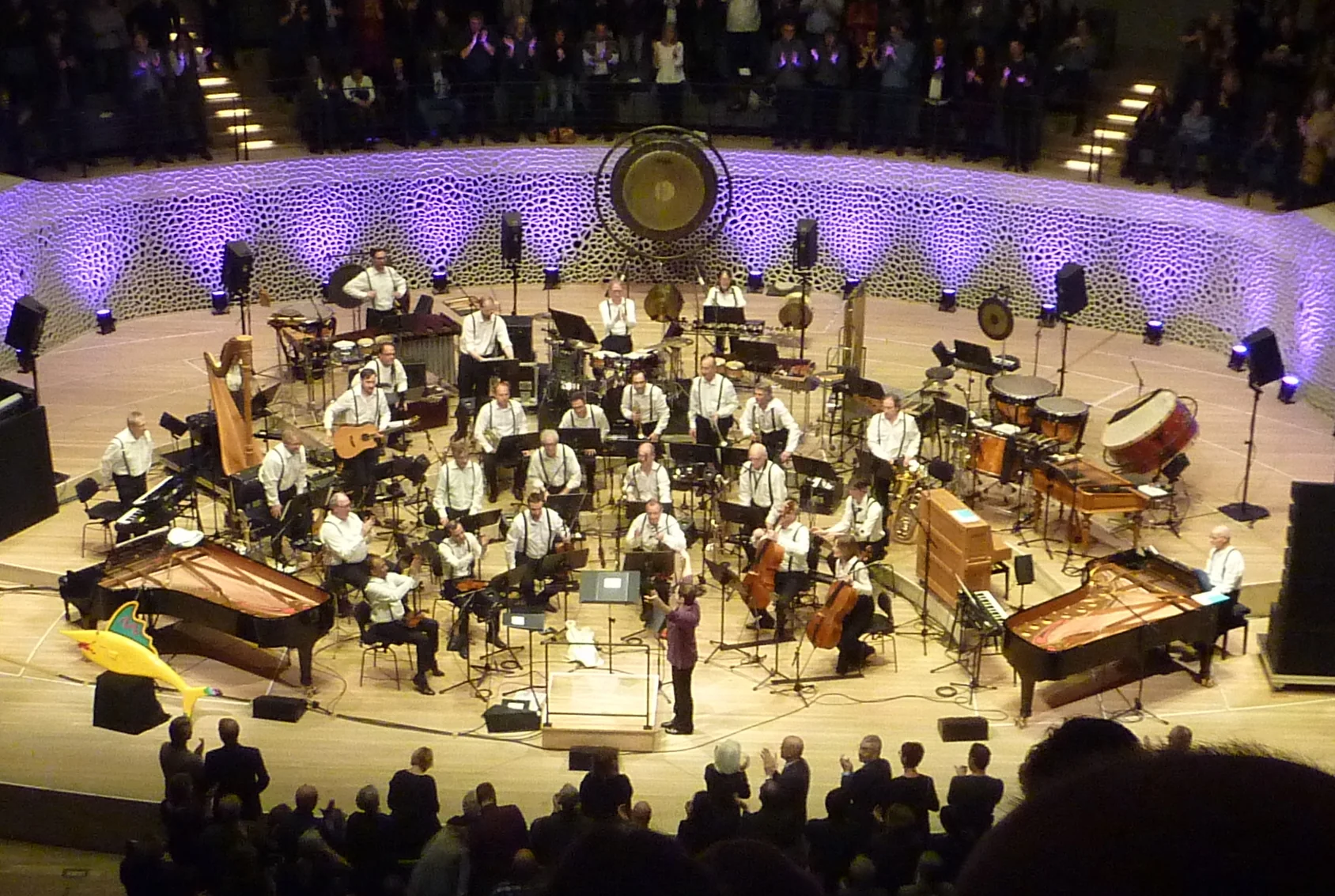
Image from Wikipedia
Image from Wikipedia
Ensemble Modern – the world-class ensemble for contemporary music from Frankfurt am Main
An ensemble that makes the present audible
Since 1980, Ensemble Modern has been one of the defining names in new music and has developed into an internationally sought-after soloist ensemble based in Frankfurt am Main. Its identity stems from a rare mix of artistic radicalism, democratic organization, and an uncompromising curiosity for current compositions. With musicians from multiple countries and a repertoire that deliberately transcends musical boundaries, the ensemble represents a music culture that always thinks in the now. ([musikprotokoll.orf.at](https://musikprotokoll.orf.at/index.php/bio/ensemble-modern))
Experiencing Ensemble Modern means not just hearing an ensemble, but encountering a precisely functioning body of sound with strong stage presence and high stylistic sensitivity. The collective performs without an artistic director, organizes its projects democratically, and develops works in close collaboration with composers. This is precisely where the aura arises that has established the ensemble as a reference point for contemporary music in music journalism and specialist media for decades. ([musikprotokoll.orf.at](https://musikprotokoll.orf.at/index.php/bio/ensemble-modern))
Founding, attitude, and artistic self-understanding
The history of the ensemble begins in 1980 with an initiative from the Junge Deutsche Philharmonie. From a student impulse emerged an institution built not on hierarchy but on collective responsibility. Frankfurt am Main has been the home of the ensemble since 1985; since 1987, it has been organized as a partnership in which the musicians themselves act as partners. This structure is not just an organizational model; it is part of the artistic signature. ([musikprotokoll.orf.at](https://musikprotokoll.orf.at/index.php/bio/ensemble-modern))
The composition of the ensemble underlines this open approach: soloists from various countries bring different cultural backgrounds into a shared sonic language. Every year, the ensemble works on around 70 new pieces, including about 20 premieres, and gives approximately 100 concerts. This showcases a work ethic that does not rely on narrow repertoire maintenance but rather on a permanent artistic presence. ([musikprotokoll.orf.at](https://musikprotokoll.orf.at/index.php/bio/ensemble-modern))
Career path: From Frankfurt to the major stages of the world
Ensemble Modern established itself early as an international player and is now regularly present at significant festivals and renowned venues. The ensemble collaborates with composers such as John Adams, George Benjamin, Helmut Lachenmann, Heiner Goebbels, Steve Reich, and Frank Zappa, which impressively demonstrates its exceptional programmatic range. This openness to different aesthetic camps makes the music career of the ensemble particularly remarkable: it combines musical precision with intellectual agility. ([penguin.de](https://www.penguin.de/autoren/ensemble-modern/672273))
The historical dimension of the work is also strong: the specialist press repeatedly emphasizes that Ensemble Modern has set important markers in the history of recorded new music. Deutschlandfunk referred to recordings of Beethoven, Schönberg, Xenakis, and the inaugural concert in 1980 as defining documents of an ensemble that not only interprets the canon of modern music but also actively shapes it. Thus, Ensemble Modern is much more than a performing collective; it is an archive of living interpretation history. ([deutschlandfunk.de](https://www.deutschlandfunk.de/15-jahre-ensemble-modern-medien-der-weitblick-eines-labels-100.html))
New music as an artistic laboratory
Ensemble Modern represents a working method that demands great proximity to composition and a high level of commitment to interpretation. The ensemble develops works in close collaboration with composers and understands authenticity as a result of intensive rehearsal work, not as a museum-like reconstruction. This is particularly evident in the high number of premieres and in formats that not only present new works but also make the creation process tangible. ([musikprotokoll.orf.at](https://musikprotokoll.orf.at/index.php/bio/ensemble-modern))
The repertoire spans from modernist key works to experimental formats bridging music theater, dance, video, and chamber music. This diversity is part of the ensemble's hallmark and explains why it is regarded as a reliable reference point in the contemporary music scene. The close ties to composers from various generations ensure that the ensemble works both analytically precisely and sonically adventurous. ([penguin.de](https://www.penguin.de/autoren/ensemble-modern/672273))
Discography, recordings, and reception
The discography of Ensemble Modern is extensive and reflects the stylistic breadth of the ensemble. The official discography features releases related to Xenakis, Beethoven, Wolfgang Rihm, Ingo Schulze, George Benjamin, Frank Zappa, and many others. These recordings are not merely documents of individual productions, but testimonies of an ensemble culture that regards recording and live interpretation as equally valid art forms. ([ensemble-modern.com](https://www.ensemble-modern.com/de/ueber-uns/diskografie/em-medien))
The specialist criticism has recognized the ensemble for decades. Wikipedia lists several awards, including the French Ministry of Culture Award, the Schneider-Schott Music Prize Mainz, the Hessian Culture Prize, as well as multiple critic awards and recording distinctions. Moreover, it has been acknowledged as a “beacon” of contemporary culture in Germany, which further underscores the cultural authority of the ensemble. ([en.wikipedia.org](https://en.wikipedia.org/wiki/Ensemble_Modern?utm_source=openai))
Current projects and releases
Even today, Ensemble Modern remains productive and visible. The official website announces concerts for 2026, such as “Checkpoint Peter Evans” and “Sound Port Frankfurt Talk - George Lewis,” while the news page highlights the new release “Dancing on a Volcano – Music between 1920 and 1933.” This release connects to the ensemble’s intensive engagement with music from the late romantic period, modernism, and political upheaval. ([ensemble-modern.com](https://www.ensemble-modern.com/en/))
Another important signal of younger work is the USA tour in 2024, which included a stop at Carnegie Hall in New York. The corresponding program featured works by Hindemith, Korngold, Schönberg, and Weill, showcasing Ensemble Modern as an instinctively and formally strong ensemble in the context of exile, musical modernity, and historical memory. Such projects demonstrate that the group not only performs new music but also places it within a cultural-historical context. ([ensemble-modern.com](https://www.ensemble-modern.com/db/datei/237_24225-em-magazin-0225-web-ds.pdf))
Musical development, style, and cultural influence
The style of Ensemble Modern is characterized by clarity, energy, and meticulous attention to sonic details. The musicians combine technical virtuosity with an analytical listening approach that makes complex scores transparent and lively. The ensemble is thus seen as an authoritative sound laboratory within the contemporary music scene: it creates interpretations that are simultaneously precise, risky, and aesthetically open. ([musikprotokoll.orf.at](https://musikprotokoll.orf.at/index.php/bio/ensemble-modern))
The cultural influence extends beyond the concert hall. With the International Ensemble Modern Academy and extensive educational work in Frankfurt schools, the ensemble transfers its knowledge to the next generation. The outreach activities, which include rehearsal visits, workshops, and projects, clarify that Ensemble Modern operates not only interpretatively but also pedagogically and culturally politically. Thus, a sustainable model for the future of new music emerges. ([ensemble-modern.com](https://www.ensemble-modern.com/db/datei/237_24225-em-magazin-0225-web-ds.pdf))
Why Ensemble Modern remains so exciting
Ensemble Modern fascinates because it does not merely manage the present of music but actively shapes it. The ensemble combines aesthetic rigor, international composition, program diversity, and a distinctive institutional spirit. For those interested in new sounds, uncompromising interpretation, and artistic development, this is one of the most important formations in the European music landscape. ([musikprotokoll.orf.at](https://musikprotokoll.orf.at/index.php/bio/ensemble-modern))
Especially live, this ensemble unleashes its full power: the intensity of interplay, the precision of articulation, and the tension between control and risk. Ensemble Modern is an experience for listeners who understand music as a living process. Anyone wishing to experience contemporary music in its highest form should definitely listen to this ensemble on stage. ([musikprotokoll.orf.at](https://musikprotokoll.orf.at/index.php/bio/ensemble-modern))
Official channels of Ensemble Modern:
- Instagram: https://www.instagram.com/p/DIjEhq6xAru
- Facebook: https://www.facebook.com/EnsembleModern/posts/1473829580857376
- YouTube: No official profile found
- Spotify: No official profile found
- TikTok: No official profile found
Sources:
- Ensemble Modern – Official Website
- Ensemble Modern – Discography
- ORF musikprotokoll – Ensemble Modern
- Penguin Random House – Ensemble Modern
- Deutschlandfunk – 15 Years of Ensemble Modern Media
- FAZ – Ensemble Modern Celebrates Anniversary and Releases a CD
- Wikipedia – Ensemble Modern
- Ensemble Modern – New Release
- Ensemble Modern – Current Dates and News
Upcoming Events
DOK.fest Augsburg: Ensemble Modern - Why we play
Ensemble Modern - Why We Play
Ensemble Modern - Why We Play
Ensemble Modern - Why We Play
Ensemble Modern - New Music of World Class
Ensemble Modern - New Music of World Class
Ensemble Modern with Transducer Piano at Friedrichsforum