
Philipp Möller
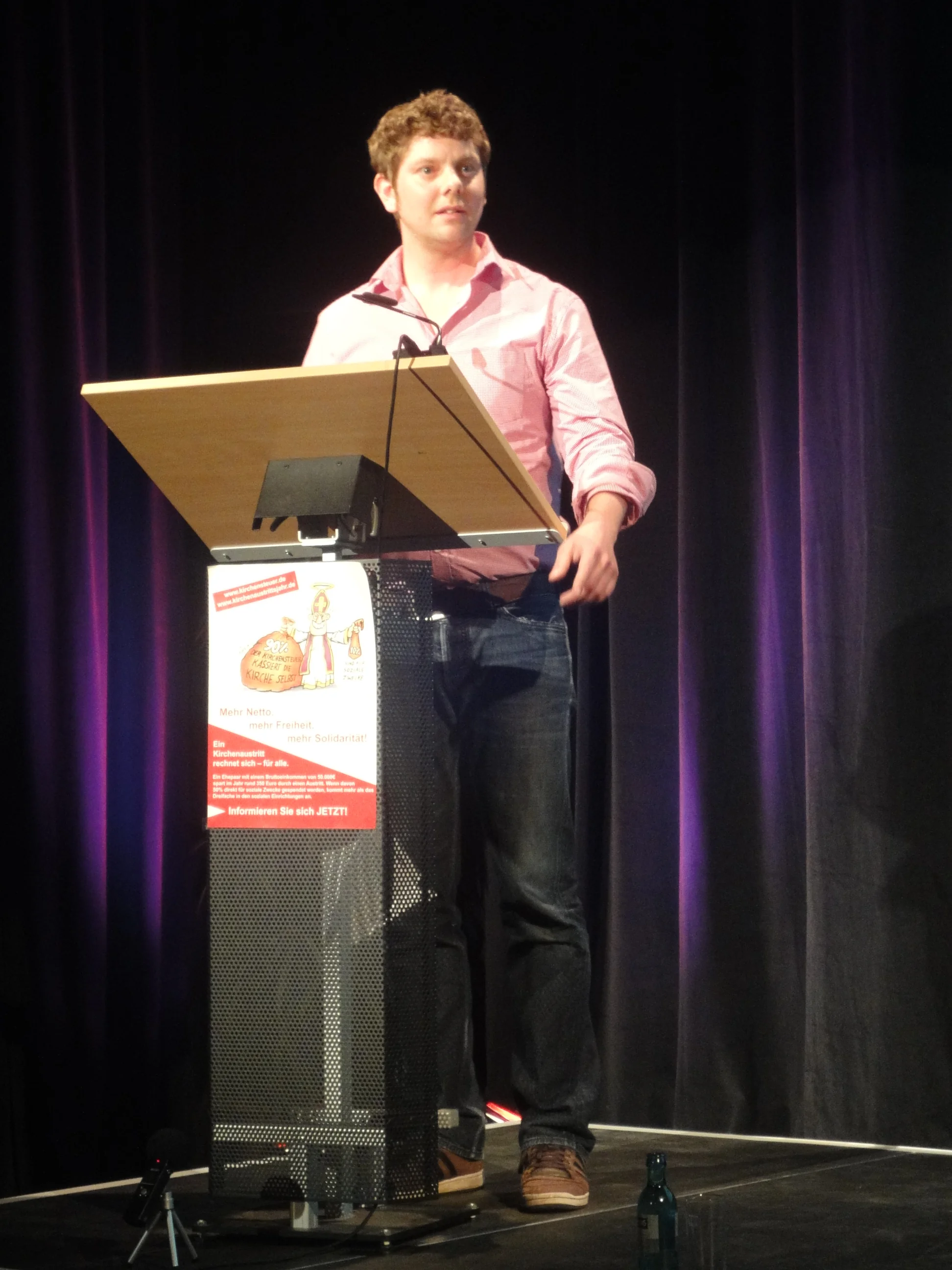
Image from Wikipedia
Image from Wikipedia
Philipp Möller – Author, Educator, and Controversial Figure in the Secular Debate
A Concise Portrait of an Author Who Connects Everyday Education, Religious Critique, and Political Public Life
Philipp Möller, born in 1980 in West Berlin, has established himself as a German author, qualified educator, and chairman of the Central Council of the Non-Religious, carving out a solid place in the German-speaking debate surrounding education, religion, and worldviews. His name is associated with books that express clear stances, public friction, and a style that merges classroom experience with political sharpness. Rather than a classical artist or musician profile, his biography reflects that of a cultural critic and non-fiction author who responds to social conflicts with humor, provocation, and a pedagogical perspective. ([de.wikipedia.org](https://de.wikipedia.org/wiki/Philipp_M%C3%B6ller))
Biographical Roots: West Berlin, Education, and an Early Distance from Religion
Möller grew up as the son of a Roman Catholic church musician from Fulda and a teacher, whom he described as "rest-religious Protestant." According to his account, religion played a minimal role in his upbringing; by the age of ten, he decided to stop participating in school religious education. This early biographical tension between a religious environment and personal distance significantly influences his later journalistic work. ([de.wikipedia.org](https://de.wikipedia.org/wiki/Philipp_M%C3%B6ller))
After studying adult education, he completed his education degree in 2008 and worked for two years as a substitute teacher in Berlin primary schools. The experiences from this time became the raw material for his first major success, as they shaped the tone, themes, and realistic perspective of his books. From the practice of a Berlin classroom, he developed not merely a collection of anecdotes, but a distinctive journalistic trademark: observant, pointed, and linguistically accessible. ([de.wikipedia.org](https://de.wikipedia.org/wiki/Philipp_M%C3%B6ller))
The Literary Breakthrough: School Life as Best-Seller Material
His book Isch geh Schulhof was published in 2012 and counted among the bestsellers of the year in 2013. The work draws directly from his teaching experiences and introduced Möller to a broader audience. The success was based not on academic distance, but on narrative closeness to everyday life, observations from the educational system, and a tone that oscillates between satire, outrage, and empathy. ([de.wikipedia.org](https://de.wikipedia.org/wiki/Philipp_M%C3%B6ller))
The subsequent books Bin isch Freak, oda was?! from 2014 and Isch hab Geisterblitz from 2015 continued this playful, relatable storytelling style. For the audiobooks of Bin isch Freak and Isch hab Geisterblitz, he enlisted the prominent speaker Christian Ulmen, which further expanded the reach of his texts. Möller's work thus extended beyond the book page into new acoustic realms. ([de.wikipedia.org](https://de.wikipedia.org/wiki/Philipp_M%C3%B6ller))
From the Classroom to the Political Public Sphere
Between June 2009 and June 2014, Möller served as press officer for the Giordano Bruno Foundation and then transitioned to its advisory board. Concurrently, from 2010 to 2012, he published the podcast Philipp Möller im Gespräch, where he interviewed atheists, agnostics, and humanists. Together with Carsten Frerk and Peder Iblher, he also initiated the so-called “godless” bus campaign in 2009, based on a British model. ([de.wikipedia.org](https://de.wikipedia.org/wiki/Philipp_M%C3%B6ller))
These positions indicate that Möller works not only as an author but as a public actor. His texts and appearances navigate the tension between enlightenment, media work, and political intervention. This combination of journalistic experience and societal ambition lends authority and recognizability to his profile. ([de.wikipedia.org](https://de.wikipedia.org/wiki/Philipp_Möller))
Godless and Happy and Isch geh Bundestag: Sharpness as a Trademark
With Gottlos glücklich from 2017 and Isch geh Bundestag from 2019, Möller shifted the focus from school more towards religion, humanism, and politics. His book Gottlos glücklich was published by S. Fischer Verlag, while Isch geh Bundestag openly displays his sympathy for liberalism and consciously embraces political friction. According to Wikipedia, the book received mixed responses, underscoring the contentious nature of his public persona. ([de.wikipedia.org](https://de.wikipedia.org/wiki/Philipp_Möller))
During the period surrounding Isch geh Bundestag, Möller worked briefly as a public relations advisor for the climate policy spokesperson of the FDP parliamentary group, Lukas Köhler. He also took positions on climate protection, supported Scientists for Future, and criticized Fridays for Future as "a bit too moralistic and not effective enough." This blend of clear political stance and conscious dissent continues to shape his role as a debate author today. ([de.wikipedia.org](https://de.wikipedia.org/wiki/Philipp_Möller))
Current Projects and Public Presence in 2025
In 2025, Möller remains visibly active as the chairman of the Central Council of the Non-Religious. The association published a position paper in February 2025 on the "confession-free school in a confession-free state," and Möller engaged in numerous discussions with representatives from politics and unions in this context. Additionally, in February 2025, he addressed the newly elected Bundestag in a personally addressed letter, calling for a paradigm shift in religious policy. ([bild.de](https://www.bild.de/ratgeber/kind-familie/grundschule/grundschule-aushilfslehrer-packt-aus-isch-geh-schulhof-philipp-moeller-26607882.bild.html?utm_source=openai))
In April 2025, Möller reaffirmed in an interview the demand for modernization of religious policy and pointed to the debate concerning church tax, special rights, and the growing number of non-religious individuals in Germany. Also in 2025, he appeared publicly for the Central Council during the Day of German Unity in Saarbrücken and reported a positive assessment of the conversations at the information booth. Thus, he remains a well-networked voice in societal conflicts beyond the book market. ([konfessionsfrei.de](https://konfessionsfrei.de/interview-mit-philipp-moeller-schon-lange-absolute-mehrheiten-fuer-saekulare-politik/?utm_source=openai))
Style, Impact, and Reception: Straight Talk Instead of Caution
Möller's writing style thrives on vividness, ironic sharpness, and a strong closeness to everyday life. His books on school, religion, and politics do not rely on academic abstraction but on concrete situations that can be easily retold and discussed. This forms a central part of his impact: he translates complex conflicts into a language that remains accessible while taking a stance. ([de.wikipedia.org](https://de.wikipedia.org/wiki/Philipp_Möller))
The public reaction also reveals a pattern of agreement, dissent, and media-effective debate. Appearances on talk shows like Anne Will, Markus Lanz, Nachtcafé, and maybrit illner anchor Möller within a media debate culture that relies on pointed arguments. His authority thus arises not from institutional calmness but from the ability to articulate conflicts succinctly. ([de.wikipedia.org](https://de.wikipedia.org/wiki/Philipp_Möller))
Discography, Musical Connections, and Cultural Context
A classical discography in the musical sense is not documented for Philipp Möller; his public work belongs to literature, journalism, and political enlightenment. However, his work displays a distinctive sonority: the titles, the language, and the performative sharpness of his appearances recall the stage presence of a spoken program. For this reason, his overall presentation is culturally and journalistically interesting, even though he does not appear as a musician or composer. ([de.wikipedia.org](https://de.wikipedia.org/wiki/Philipp_Möller))
His biographical background with a church musician as a father also generates a subtle musical connection, which is more cultural than artistically work-related. This origin in the tension between church music, religion, and secular critique shapes the tone of his texts: rhetorical, rhythmic, direct. This creates a kind of literary stage presence that also remains accessible to readers from cultural and music journalism. ([de.wikipedia.org](https://de.wikipedia.org/wiki/Philipp_Möller))
Cultural Influence: Humanism, Education, and Debate Culture
Möller's cultural influence is primarily derived from his combination of educational experience and worldview positioning. As an author who writes from everyday school life, and as the chairperson of a secular advocacy group, he addresses audiences interested in state neutrality, education issues, and the role of religion in public life. His work engages with central questions of contemporary German culture. ([de.wikipedia.org](https://de.wikipedia.org/wiki/Philipp_Möller))
At the same time, his career illustrates how non-fiction authors can generate public impact today: through books, interviews, podcasts, association work, and digital press formats. Möller is not a reclusive desk author but an actor in the political and cultural space. This makes him intriguing to readers who see authorship not just as literature but as social intervention. ([de.wikipedia.org](https://de.wikipedia.org/wiki/Philipp_Möller))
Conclusion: An Author with Stance Who Does Not Shy Away from Debates
Philipp Möller remains compelling because he has transformed personal experience, pedagogical practice, and political sharpness into a distinctive voice. His books connect everyday observations with clear argumentation, while his public appearances provide pointed critiques of the present. Those who experience him live encounter not a neutral narrator but an author who passionately represents his themes with energy, precision, and a willingness to provoke. ([de.wikipedia.org](https://de.wikipedia.org/wiki/Philipp_Möller))
Official Channels of Philipp Möller:
- Instagram: No official profile found
- Facebook: No official profile found
- YouTube: No official profile found
- Spotify: No official profile found
- TikTok: No official profile found
Sources:
- Wikipedia – Philipp Möller
- S. Fischer Verlage – Philipp Möller
- Central Council of the Non-Religious – Interview with Philipp Möller, April 9, 2025
- Central Council of the Non-Religious – Guest Contribution by Philipp Möller, March 16, 2025
- Central Council of the Non-Religious – Address to the new Bundestag, February 2025
- Central Council of the Non-Religious – The Central Council on the Day of German Unity 2025 in Saarbrücken
- Giordano Bruno Foundation – GEW advocates for confession-free schools
- S. Fischer Verlage – Author Page Philipp Möller
Upcoming Events
True Crime Show with Philipp Möller
True Crime in Neubrandenburg
True Crime in Neubrandenburg - Fascinating Insights